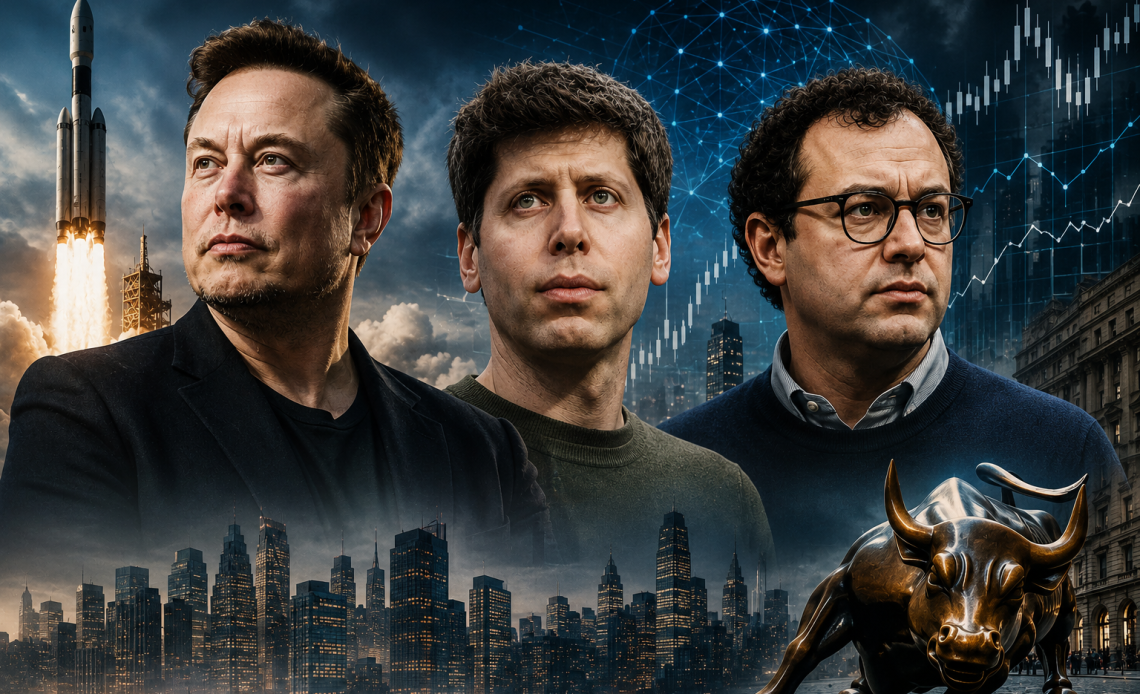
Silicon Valley is heading toward what could become one of the most consequential listing waves in modern market history, with artificial intelligence heavyweights SpaceX, OpenAI, and Anthropic preparing to enter public markets at valuations that could redraw the hierarchy of global corporations.
After several subdued years for technology listings, the expected debuts of the three companies are reigniting excitement across Wall Street.
Bankers, venture capital firms, and retail investors are positioning themselves for offerings that could collectively absorb hundreds of billions of dollars in market capitalisation and redefine how public investors participate in the AI economy.
“In two decades, I haven’t seen private companies that are this meaningful and are this impactful,” said Jeremy Abelson, an investor at Irving Investors, a firm that backs start-ups before they go public, in a NYT report.
“Not only are they bigger and more relevant, but they’re incredible companies with numbers that we’ve never seen before, ever.”
However, while supporters argue the companies represent transformative platforms with unprecedented growth potential, critics warn that valuations are racing far ahead of proven profitability.
SpaceX’s IPO filing triggers widespread scrutiny
Among the upcoming debuts, Elon Musk’s SpaceX is expected to dominate investor attention.
The rocket and satellite company confirmed in a regulatory filing on Thursday that it plans to pursue a Nasdaq listing, with reports indicating the company could seek a valuation between $1.75 trillion and $2 trillion.
SpaceX is reportedly aiming to raise roughly $75 billion, a figure that would shatter the previous US IPO record set by Alibaba’s $21.8 billion listing in 2014.
The company has evolved from a launch provider into a sprawling technology empire spanning satellite broadband, reusable rockets, AI infrastructure, and ambitions to colonise Mars.
SpaceX’s valuation pitch increasingly rests not only on its existing operations, but on future industries Musk believes the company can dominate.
Investors are being asked to bet on a chain reaction of technological and commercial breakthroughs: Starlink generating cash flow, Starship dramatically reducing launch costs, and lower-cost space access eventually supporting massive AI and data-centre businesses in orbit.
“The risk isn’t whether SpaceX is a real business; it clearly is,” said Josh Gilbert, analyst at eToro, a trading platform where the stock will be available on the day of debut, in a Reuters report.
“The risk is whether a $1.75 trillion valuation adequately prices in the execution challenges that come with being part rocket company, part internet provider, part AI venture, and very much driven by the vision of one individual.”
Despite the excitement surrounding the listing, SpaceX’s S-1 filing revealed mounting financial pressures.
The company posted losses of $4.28 billion in the three months ended March 31, an eightfold increase from a year earlier.
Those losses are likely to complicate traditional valuation models and reinforce the idea that investors are largely buying into Musk’s long-term vision rather than near-term earnings.
Economist Jay Ritter of the University of Florida, often referred to as “Mr. IPO,” found that mega-cap IPO companies typically underperform the market by 3% to 5% annually over the five years following an IPO.
His research also showed that companies entering public markets with more than $1 billion in revenue have produced market-adjusted returns of minus 2.1% over three years.
Still, analysts believe retail enthusiasm around Musk could override many conventional valuation concerns.
“Humans are prone to herding and when they hear about how monumental this may be, they don’t want to miss out,” Brian Jacobsen, chief economic strategist at Annex Wealth Management, said in a Reuters report.
Unlike traditional IPOs built around predictable earnings and stable forecasts, SpaceX is marketing itself as a once-in-a-generation platform company tied to the future of AI, communications, and space infrastructure.
OpenAI could list in September, but profitability and spending questions remain
OpenAI, the company behind ChatGPT, is also moving closer toward a public debut after years of explosive growth and escalating competition.
According to reports, the company has been working with Goldman Sachs and Morgan Stanley on a draft IPO prospectus and may file confidentially with regulators in the coming weeks.
OpenAI is reportedly targeting a listing as early as September.
“Resolving that legal overhang removed a major obstacle to an IPO and likely gave OpenAI the confidence to accelerate its timeline,” IPOX Vice President Kat Liu said in a Reuters report.
OpenAI was last valued at $852 billion, while prediction market traders on Polymarket see a strong possibility that the stock could finish its first trading session above a $1.4 trillion valuation.
The company’s rise since launching ChatGPT in late 2022 has helped ignite the global AI investment frenzy.
Yet investor concerns have also mounted over its massive spending requirements, leadership turnover, and questions about long-term profitability.
The Information reported that OpenAI expects to burn roughly $25 billion this year alone.
The company generated more than $13 billion in revenue last year but reportedly expects to spend $115 billion over the next four years as competition intensifies.
OpenAI’s dominance is increasingly being challenged by rivals, including Alphabet-owned Google and Anthropic.
Google recently said its Gemini app had reached 900 million active users, matching ChatGPT’s scale.
At the same time, OpenAI continues renegotiating partnerships, expanding enterprise services, and investing heavily in computing infrastructure.
Fabien Yip, market analyst at IG, said OpenAI’s eventual listing could become the benchmark for how public markets value standalone AI companies.
“Depending on the sequencing relative to Anthropic, OpenAI’s debut may establish the first US benchmark for pure-play AI model valuations, with direct read-through to its infrastructure partners Nvidia, Oracle, and CoreWeave,” Yip wrote.
She added that the IPO could create more complicated consequences for Microsoft and SoftBank, whose investments in OpenAI may be repriced once public investors can directly buy shares in the AI company itself.
Anthropic edges toward profitability ahead of IPO
Anthropic, meanwhile, is emerging as a potentially more financially disciplined AI contender.
Prediction market traders currently place high odds on Anthropic completing an IPO this year, while reports suggest the company is discussing a funding round at a valuation approaching $900 billion.
Unlike many AI rivals, Anthropic is reportedly nearing profitability.
A person familiar with the matter told Reuters that the company could post its first quarterly operating profit soon, as enterprise demand for its Claude AI models accelerates.
Anthropic’s June-quarter revenue is expected to reach at least $10.9 billion, more than double the prior quarter’s level.
The company’s Claude products are increasingly being used by software developers and enterprises for programming assistance and cybersecurity applications.
According to The Wall Street Journal, Anthropic expects to break even by 2028 — earlier than OpenAI’s projected profitability timeline.
“A successful Anthropic IPO would crystallise gains for Amazon and Alphabet,” Yip said, adding that companies such as Nvidia and Broadcom could also benefit from Anthropic’s infrastructure spending.
Yip added that the competitive dislocation is already visible: Anthropic’s Claude Cowork and Claude Code products have triggered a broad repricing of enterprise software, with Salesforce and ServiceNow each losing approximately a third of their market value year-to-date, while Thomson Reuters, RELX, and FactSet bore the brunt of investor concerns over AI disruption to legal and financial data workflows.
“A public listing at a near-trillion-dollar valuation would likely entrench and accelerate that repricing,” she said.
Why investors must exercise caution
None of the three companies has yet delivered a full-year profit, although Anthropic is widely expected to report its first profitable quarter in its upcoming results.
Even so, analysts say the underlying economics of these AI businesses remain difficult to assess, with limited transparency around long-term profitability and spending requirements prompting some market watchers to caution investors against chasing the IPO frenzy too aggressively.
The enormous valuations attached to all three companies are also beginning to revive memories of previous speculative booms.
“I see it as a market top,” John Blank, chief equity strategist at Zacks, told CNBC’s Squawk Box Europe on Thursday.
“Everybody knows the top is pretty close to being around and usually it is advertised by these giant IPOs. Back in 1999, we saw the same kind of thing where people were just rushing to get these IPOs out.”
Combined valuations for SpaceX, OpenAI, and Anthropic could place all three comfortably above the $1 trillion mark, rivaling companies such as Berkshire Hathaway, Meta, and Tesla.
Deutsche Bank analyst Adrian Cox noted in a Thursday report that the revenue gap between traditional corporate giants and the new wave of AI companies remains stark despite their soaring valuations.
Berkshire Hathaway generated more than $350 billion in revenue last year, compared with SpaceX’s $18.67 billion in 2025 revenue and OpenAI’s reported $13.1 billion.
The eye-popping valuations attached to these IPO candidates also reflect a broader trend of companies remaining private for longer, aided by abundant access to private capital markets.
Still, the prospect of several mega-sized technology listings arriving within months of each other has sparked concerns over whether public markets can absorb such enormous offerings without straining investor demand.
Cox, however, argued that fears about limited market capacity may be overstated.
“While there may be concerns about the capacity of the market to absorb a number of IPOs valued at several hundred billion dollars this year, they would slot into a US stock market worth about $70 trillion overall,” he wrote.
“That is five times larger in nominal terms than it was even at the peak of the dot-com bubble in the late 1990s. At that time, there was an average of almost 500 IPOs a year, compared with about 120 this decade.”
Deutsche Bank also warned that public investors may become far more demanding once these companies are forced to disclose detailed financial information on a regular basis.
“It has yet to be seen how public markets will value OpenAI and its peers once they open up their financial statements to scrutiny and explain the still little-understood economics of their business models,” Cox wrote.
The post Fears and frenzy mount as SpaceX, OpenAI and Anthropic prepare for a $4T AI IPO wave appeared first on Invezz