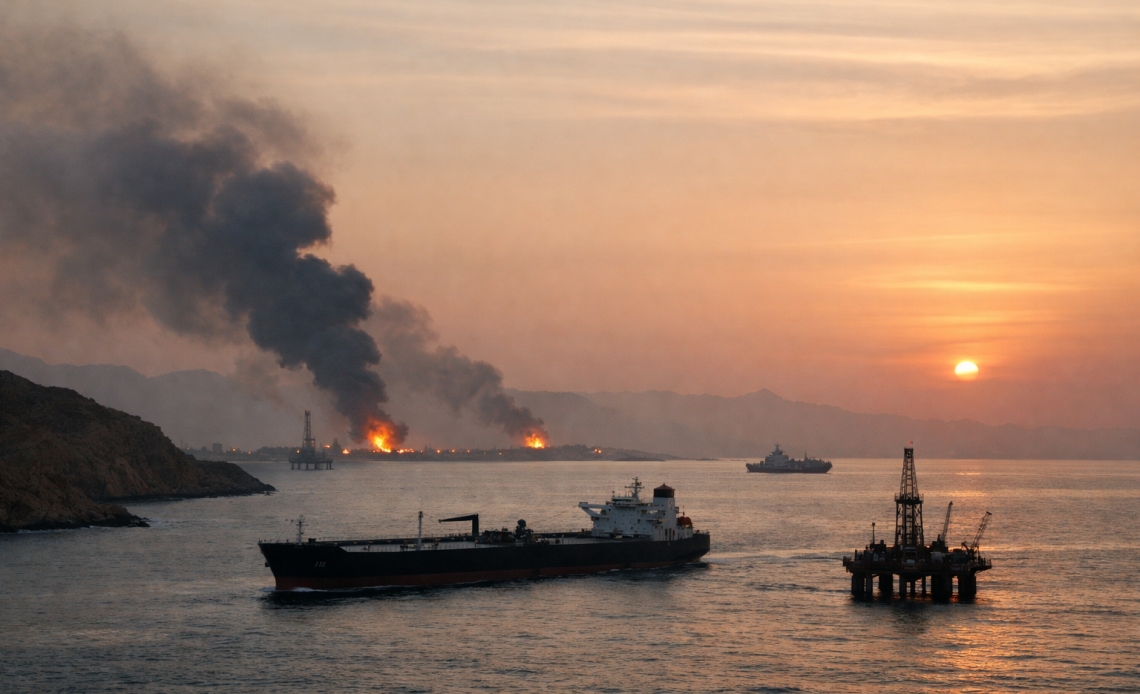
Shipping traffic through the Strait of Hormuz has slowed dramatically, with only five vessels, including a single Iranian oil products tanker, passing through in the last 24 hours, according to Friday’s shipping data.
The sharp decrease follows Iran’s seizure of two container ships this week and an ongoing US blockade of Iranian ports, escalating maritime tensions in the critical waterway.
Before the Iran war began on February 28, the crucial waterway at the entrance to the Gulf typically saw an average of 140 shipping passages daily.
However, due to an uneasy ceasefire between Washington and Tehran, current shipping traffic through this passage is significantly reduced, representing only a fraction of that average.
Escalating tensions and Hormuz traffic slowdown
“For most shipping companies, they will need a stable ceasefire and assurances from both sides of the conflict that the Strait of Hormuz is safe to transit,” Jakob Larsen, chief safety and security officer at shipping association BIMCO was quoted as saying in a Reuters report.
In the meantime, shipping will be restricted to using routes close to Iran and Oman. Due to their confined nature, these routes cannot safely accommodate the normal volumes of shipping through the Strait of Hormuz.
The difficulty for vessels entering or leaving the Middle East Gulf has significantly increased since April 13.
Initially, the primary concern during the first month and a half of the conflict was solely the Strait of Hormuz.
However, the targeted US blockade of Iranian or Iran-related vessels is now much broader geographically.
Vortexa is tracking energy tanker activity on the water, specifically focusing on sanctioned vessels and those with Iranian connections, in relation to the US Naval Blockade.
The Iranian-flagged oil products tanker Niki, which is currently under US sanctions, was one of the few ships observed leaving the strait with no destination specified, according to tracking data from the MarineTraffic platform and analysis by Kpler on Friday.
Tankers from the eastern part of the UAE or Oman are reportedly free to pass.
Traffic and Iranian-linked tanker tracking
Between April 13 and April 21, 34 energy tankers with Iranian links traveled through the strait, both inbound and outbound, according to Vortexa data.
During the same period, six dark outbound transits were recorded, carrying 10.7 million barrels of Iranian crude.
As of April 22, the US has reportedly interdicted three of these six vessels, Vortexa said in a report from earlier this week.
Little prospect of peace talks resuming is evident nearly two months after the US and Israel launched strikes on Iran.
A Hapag-Lloyd container ship successfully navigated the strait, the group announced on Friday, though details regarding the time and circumstances were not provided.
Heightening concerns among numerous shipping and oil companies was Iran’s recent action: the seizure of two container ships near the strait on Wednesday using a swarm of small, fast boats.
In other news, the Comoros-flagged supertanker Helga arrived at the offshore oil loading terminal in Iraq’s southern Basra port on Friday.
This marks the second vessel to reach Iraq since the strait’s closure.
Analysis from Lloyd’s List Intelligence reveals that of the seven vessels which transited the strait between April 22 and early April 23, six were involved in Iran-related trade.
Meanwhile, Vortexa said despite heightened tensions, the baseline throughput of transits has been largely maintained via the Strait of Hormuz.
An average of 4.5 transits per day were observed between April 13-21, a slight increase from the 4 transits per day in the preceding 30 days.
However, since the imposition of the US blockade, Iran-linked activity has decreased.
Tanker transits through the Strait of Hormuz declined to 1-2 per day between April 13-21, down from 2-3 per day in the month prior.
Impact on Iranian crude flow
Although the US blockade has garnered significant media attention, fundamentally, it is not anticipated to have a meaningful impact on Iranian crude supply to the market over the medium term (two to three months), according to Vortexa.
The reason for the continued seaborne crude imports is that approximately 160 million barrels of Iranian crude are currently at sea.
Of this total, 130 million barrels have already passed outside the area subject to the US blockade, Vortexa data showed.
“This is sufficient to supply about 2.5 months of typical Chinese import needs, and more vessels are likely to trickle through the US net,” Claire Jungman, director of maritime risk & intelligence, said in a report.
And Iranian oil production is unlikely to be immediately constrained because it would take 22 days for Iran to reach its maximum observed fill level since 2020, if it stores 1.5 mbd of crude production in storage tanks.
Additionally, ballast tanker capacity is potentially sufficient to maintain production for as long as two months; however, preemptive production cuts are probable sooner.
It is important to remember that these estimates assume a complete, 100% obstruction of Iranian oil traffic by the US blockade, an outcome that initial reports suggest is improbable.
The post Hormuz traffic slows, but Iran already has 2.5 months of oil supply at sea appeared first on Invezz