The war with Iran has already shaken oil markets, but the latest US strike on Kharg Island reveals something deeper about how this conflict may unfold.
The island is not just another military target in the Persian Gulf. It is the point where Iran’s economy connects to the global oil system.
Washington hit military installations there on Friday night while leaving the oil terminals untouched. That choice says more about the strategy of the war than any speech from the White House.
The small island that carries Iran’s oil
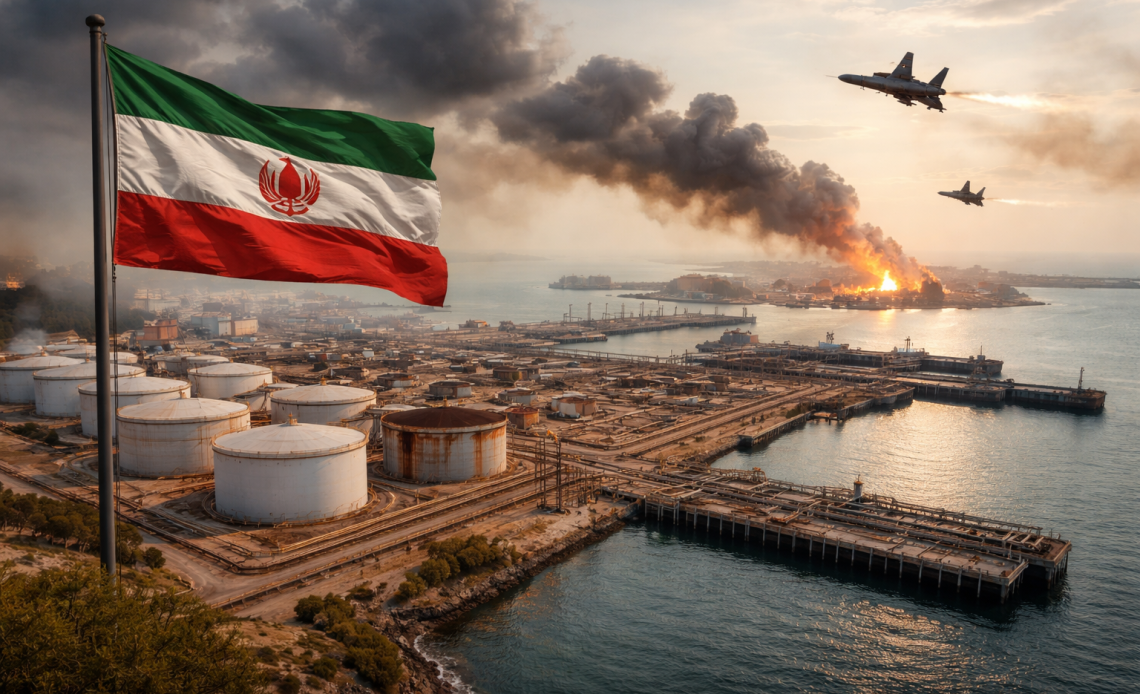
Kharg Island sits roughly 26 kilometers off Iran’s coast in the Persian Gulf. It is not large. Yet it handles nearly 90% of Iran’s crude exports, with nearly 1 billion barrels passing through each year.
Pipelines from major oil fields run directly to the island. Large storage tanks hold crude before it is loaded onto tankers at long offshore jetties.
These terminals can accommodate the largest crude carriers in the world, the vessels that move oil across oceans to refineries.
Most of that crude now goes to China, which has become the dominant buyer of Iranian oil under sanctions.
Tanker tracking groups estimate that Iran has been exporting roughly 1.1 million to 1.5 million barrels per day during the war. Nearly all of it passes through Kharg.
If the island stops operating, Iran’s oil exports fall sharply. Few alternative ports can handle the same volume of shipments.
For a country that depends heavily on oil revenue, the island functions like a valve. Turn it off and the flow of cash slows quickly.
Why the US struck but spared the oil
President Donald Trump said US forces destroyed military targets on Kharg Island but avoided oil infrastructure. Iranian media reported explosions near air defense systems, a naval base and other military facilities.
Leaving the oil terminals intact was not accidental. Destroying them would have produced immediate global consequences. The International Energy Agency already says the war has caused the largest oil supply disruption on record.
Taking Iran’s exports offline would further tighten the market and drive prices higher at a time when shipping in the Strait of Hormuz is already under pressure.
The strike instead removed defensive assets while leaving the economic lever untouched.
The message is straightforward. Washington can reach Iran’s most valuable oil hub whenever it wants, but it has not pulled that trigger yet.
Energy infrastructure now sits in the middle of the conflict as a bargaining chip.
The shipping lane everyone depends on
Kharg’s importance grows when its location is considered.
The island sits inside the Persian Gulf, not far from the Strait of Hormuz. That narrow channel carries around one-fifth of the global oil trade.
For the past two weeks, traffic through the strait has slowed dramatically as ships avoid the region and insurance premiums climb.
Some Gulf exporters have already limited shipments due to security concerns.
If tanker traffic stops completely, the impact spreads well beyond Iran. Saudi Arabia, Kuwait, Iraq and the United Arab Emirates all rely on the same route to send crude to Asia and Europe.
That is why the United States has signalled the Navy will begin escorting tankers through the strait.
The objective is simple. Keep oil moving and prevent a supply shock that would reach far outside the Middle East.
Energy markets understand the risk. Oil prices have jumped more than 40 per cent since the war began.
The targets that could escalate the war
Iran has warned that any attack on its oil infrastructure will trigger retaliation against energy facilities linked to the United States across the region.
That threat includes refineries, export terminals and pipelines.
Several sites stand out in the global energy system.
The Abqaiq oil processing facility stabilises much of Saudi Arabia’s crude output before export. The Ras Tanura oil terminal is one of the largest loading ports in the world.
The Fujairah oil hub serves as a major storage and shipping center outside the Strait of Hormuz.
A reminder of the risk came in 2019 when drones struck Saudi facilities at Abqaiq and temporarily removed about 5% of global oil supply.
That happened during a relatively stable market. The same disruption during an active war would hit an already tight system.
So far, the fighting has largely avoided direct attacks on oil infrastructure. That restraint may not hold forever.
What investors should watch now?
The most important signals in the coming weeks may not come from battlefield updates but from oil logistics.
Tanker movements, shipping insurance rates and loading activity at Kharg will reveal more about the direction of the conflict than daily military briefings.
Iran still appears to be exporting crude through the island, although the pace has fluctuated as ships hesitate to enter the Gulf.
Analysts at JPMorgan Chase & Co. estimate that if the island remains operational, Iran could maintain export capacity near 1.5 million to 1.7 million barrels per day.
If the island’s pipelines, storage tanks or loading jetties were damaged, production cuts would likely follow. Iranian fields cannot keep pumping indefinitely without somewhere to send the oil.
For investors, the significance of Kharg Island goes beyond a single facility. It has become the pressure point of the entire conflict.
Military planners understand that fact, and so do energy traders.
Oil is trading close to the psychological threshold of $100 per barrel. Markets know that Kharg still operates today.
They also know how quickly that could change. And the worst-case scenario is not yet priced in.
The post US attacks Kharg Island: why this oil chokepoint could play the decider? appeared first on Invezz