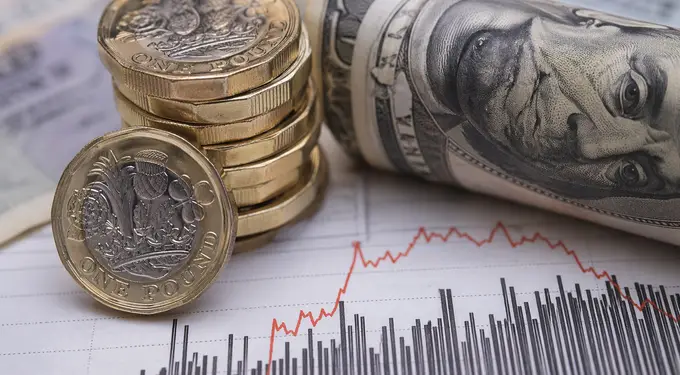
The British pound rose marginally against the US dollar on Friday but remained on track for a weekly loss, as geopolitical uncertainty and cautious market sentiment continued to weigh on currency movements.
Sterling was up 0.1% at $1.348, as broader foreign exchange markets remained largely range-bound.
However, despite the modest daily gain, the currency was still heading for a weekly decline, reflecting persistent concerns around stalled peace negotiations between the United States and Iran.
Against the euro, the pound slipped 0.1% to 86.69, indicating mixed performance across major currency pairs.
Retail sales beat expectations but fail to lift sentiment
Official data showed that UK retail sales rose more than expected in March.
The increase was largely driven by a surge in fuel purchases, as British motorists rushed to fill up following the start of the Iran conflict.
Despite the stronger-than-anticipated data, the impact on sterling was limited.
Analysts noted that while spending remained resilient, broader economic concerns continued to cap gains.
“There had been concerns that the uncertainty over the impact of the situation in the Middle East on household finances might dampen consumers’ appetite to spend, but even the figures for March were fairly robust,” Investec economists wrote in note, as cited in a Reuters report.
The data, however, followed a separate survey released on Thursday that painted a weaker picture of consumer confidence.
The survey showed that British consumer morale fell to its lowest level since October 2023, as households raised their expectations for future price increases.
Geopolitical tensions fuel inflation concerns
The ongoing conflict in the Middle East has triggered a global spike in energy prices, raising concerns about inflation and economic growth.
The closure of the Strait of Hormuz, a key route for global energy supplies, has added to market uncertainty and weighed on the outlook for the British economy.
Sterling had dropped 1.9% in March amid these developments.
However, the currency has since recovered those losses in April and is now on track for its strongest monthly gain since August.
Bank of England outlook remains cautious
Market expectations for Bank of England policy have shifted notably in recent weeks.
Traders are now pricing in at least one 25-basis-point rate increase this year, a reversal from earlier expectations of two rate hikes before the escalation of geopolitical tensions.
The central bank is set to announce its next policy decision on Thursday.
Markets are currently assigning an 83% probability that the Bank of England will keep interest rates unchanged at 3.75%.
Meanwhile, concerns about broader financial market risks persist.
Bank of England Deputy Governor Sarah Breeden warned that global stock markets could face declines, noting that current valuations may not fully reflect existing economic risks.
The warning underscores the fragile balance facing policymakers and investors, as geopolitical tensions, inflation pressures, and shifting rate expectations continue to shape market dynamics.
The post Pound edges higher but set for weekly loss amid Middle East tensions appeared first on Invezz